
What Is an Urban Winery, and How Is It Different From a Vineyard Estate?
You know the vineyard estate. Everyone knows the vineyard estate. Long gravel driveway, rows of vines marching up a hillside, a tasting room that used to be a barn and now has better lighting than your house. You drive forty-five minutes, you tip a flight, you buy a bottle you’ll forget you own by October.
An urban winery is the same idea with the driveway removed. We make wine from grapes grown elsewhere — real vineyards, real growers, real dirt — and we bring the fruit to town to ferment, age, and pour it. No estate vineyard out back. No rows to walk. Just a building downtown where the wine happens and the people are. In our case, that building is in Ashland, and we are the only tasting room actually in it.
Wait, so the grapes don’t come from your property at all?
Correct, and we’d rather tell you that upfront than let you find out after you’ve asked where our vineyard is and watched us gesture vaguely at the highway. We source fruit — from Applegate Valley, from growers we trust, from regions that do a specific grape better than we ever could on a half-acre behind a tasting room. Then the actual winemaking — the decisions that matter, the ones that turn grape juice into something you’d pay fifty dollars for — happens here, in town, by us.
This is not a lesser model. It’s a different one. A vineyard estate is betting everything on one patch of land. An urban winery is betting on judgment: which grapes, which growers, which vintage, which barrel. We’ll take that bet. Mostly because Kimberly is in charge of winemaking, and neither of us seems to be in charge of farming — ask us about the birds sometime, or don’t, it still stings.
Does that mean the wine is worse, or just different?
Different. Possibly better, depending on how you feel about a Cabernet Sauvignon fermented by someone who has never once had to worry about frost damage personally. The fruit in our 2022 Cabernet Sauvignon came from vines that somebody else lost sleep over. We just get to make the decisions once it arrives — how long it sits on skins, what the oak program looks like, when it’s actually done being a wine and not a science project. An estate winemaker is married to one vineyard’s personality every single year, good vintage or bad. We get to go shopping. There are worse arrangements.
So what’s actually happening inside an urban winery, day to day?
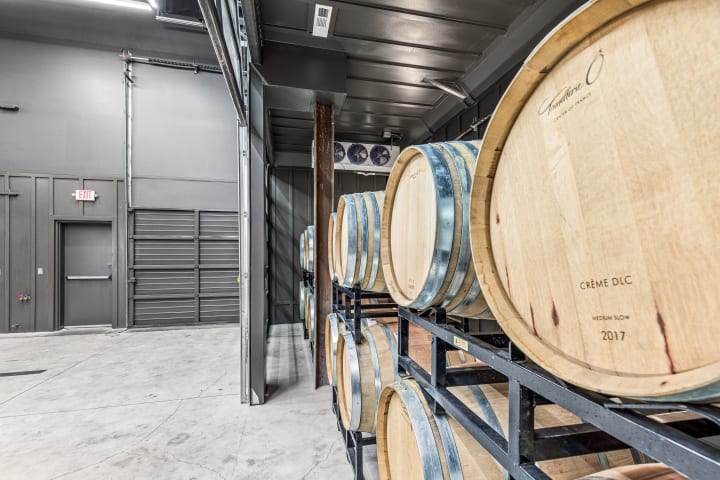
Fermentation, aging, blending trials, and a surprising amount of standing around a barrel arguing about whether it’s ready. Our Barrel Room does exactly what the name says — it’s where the wine ages while it figures out who it’s going to be. No tanks lined up like a chemistry set, nothing that hums. Just barrels, quiet, doing the unglamorous work of turning something sharp into something you’d want a second glass of.
And because we’re downtown instead of up a hillside, you don’t need a plan. You don’t need a tour slot. You walk in the way you’d walk into a restaurant, and the people pouring your wine are the same people who decided what’s in the bottle. Lin runs the tasting room. Kimberly made the wine. Ask a hard question and you might actually get a straight answer instead of a script.
Is this why urban wineries feel less stuffy than estate tasting rooms?
That’s our theory, and we’re sticking to it. An estate tasting room comes with scenery, and scenery makes people behave like they’re at a wedding they weren’t close enough to the couple to be invited to — hushed voices, careful questions, the smug satisfaction of knowing the difference between a Malbec and a Merlot and needing you to know they know it. An urban winery doesn’t have a view to live up to. We have a sidewalk. Nobody whispers on a sidewalk.
So the bar for pretension drops considerably, and the bar for actually enjoying your afternoon goes up. You can order a glass of our 2025 Sauv Blanc and not perform anything about it. It’s crisp, it’s citrusy, it wants to be on a patio with you while it’s still warm enough to pretend you have nowhere to be. Nobody’s going to ask you to swirl correctly.
Does an urban winery make every kind of wine, or does it specialize?
Depends on the winery, but for us: a little of everything, because we like it that way and because sourcing from multiple regions means we’re not stuck making one grape’s apology tour every vintage. We’ve got structured reds that take their time — the 2022 Tempranillo, the 2023 Sangiovese, the 2021 Malbec — and the kind of white and rosé program that doesn’t take itself nearly as seriously.
Speaking of which: our rosé is made from Merlot, which is unusual enough that other wineries bring it up like we did something wrong. We didn’t. It will never score well with the people who score these things, and everyone drinks it anyway, especially the people who swear up and down they hate rosé. Kirk’s grandfather once brought a bottle of White Zinfandel to a family gathering sometime in the 80s. Ours is better, and you get to keep your dignity and skip the Miami Vice look entirely.
Does a wine made from sourced fruit still count as a real wine, or is it somehow less legitimate?
It counts. It is real. The legitimacy question is mostly wine snobbery dressed up as a technical concern, and wine snobbery is always fair game around here. Nobody asks a chef whether the tomatoes being grown somewhere else makes the sauce less real. The skill isn’t in owning the dirt. The skill is in knowing what to do once the fruit shows up at your door, and in having the patience to let a 2020 Syrah sit in a barrel for as long as it actually needs instead of as long as the calendar says it should.
If anything, sourcing fruit forces more honesty into the process. An estate winemaker can blame a bad vintage on bad luck and still bottle it, because what else are they going to do with the grapes. We get to be pickier. If a lot isn’t working, it doesn’t have to become a bottle with our name on it. That’s not a loophole. That’s the whole advantage.
How do I actually taste the difference between urban and estate wine, if there is one?
You probably can’t, blind, and anyone who tells you they can with total confidence is the same person nodding at a wine like they just diagnosed something, possibly you. What you can taste is whether the wine was made with attention — and that has nothing to do with whether there’s a vineyard visible from the parking lot.
Come taste it yourself. Our 2022 Wingman Syrah doesn’t know or care that it wasn’t grown behind the building it was bottled in, and neither should you. We take the wine seriously. The real estate, not so much.